Genus

Betapolyomavirus

Editor: John A. Lednicky
Authors: Janet S. Butel, John A. Lednicky

Virion

Simian virus 40

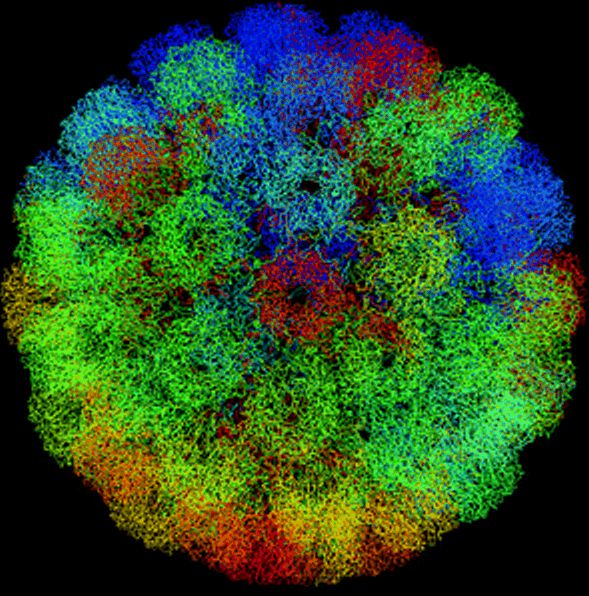
This cartoon depicting SV40 was created by Stefan A. Welte, University of Tübingen using ProteinExplorer (Martz 2002) (www.proteinexplorer.org) and the PDB code 1sva (Liddington et al 1991)


Morphology Icosahedral
Envelope No
Diameter (nm) 45
Length (nm) -
Structural Components Capsid, minichromosome
Buoyant Density (g/ml) 1.34
Buoyant Density Method
Lipid Composition
Additional Information Composed of 72 pentameric capsomers; T = 7

Genome

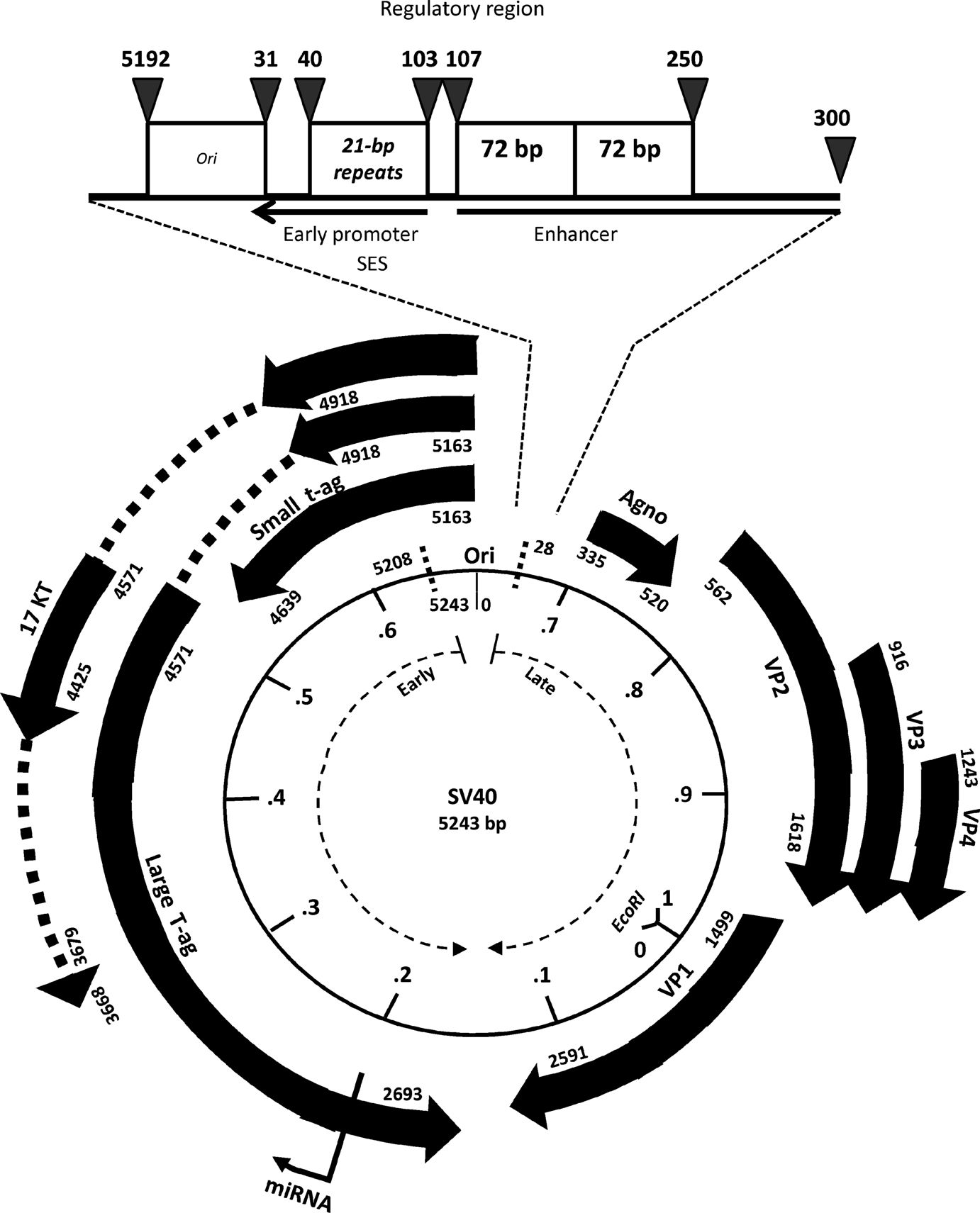
Genome organization of polyomavirus simian virus 40, strain 776

The circle represents the circular SV40 DNA genome. Nucleotide numbers begin and end at the origin (Ori) of viral DNA replication (0/5243). Unique Bgl-1 and Sfi-1 sites flank the Ori. A unique EcoRI site is shown at map unit 0/1. Boxed arrows indicate the open reading frames that encode the viral proteins. Arrowheads point in the direction of transcription; the beginning and end of each open reading frame is indicated by nucleotide numbers. The regulatory region is shown at the top; Ori, origin of DNA replication; 21-bp repeats, GC-rich SP1 binding sites and location of the SES; 72-bp, tandemly repeated 72-bp sequences within the enhancer. Numbers above the diagram identify nucleotide positions that border specific regulatory region segments.


Nucleic Acid DNA
Strandedness Double-stranded
Polarity -
Configuration Circular
Segments 1
Size (kb) 5.3
G+C Content (%) 47.3
mRNA Transcripts 7
Open Reading Frames
Additional Information Genome is nonsegmented, closed circular, supercoiled; viral minichromosome within virions is complexed with histones H2A, H2B, H3, and H4, but lacks H1

Replication

No images available

Image Info

Image Permissions/Origin


Entry Mechanism Caveolae- or clathrin-mediated endocytosis
Site of Transcription Nucleus
Transcriptase Host cell RNA polymerase II and its accessory proteins
Site of Genome Replication Nucleus
Replicase SV40 large tumor antigen, DNA pol alpha-primase, DNA pol delta/RFC/PCNA
Replication Intermediate Unknown
Site of Virion Assembly Nucleus
Egress Mechanism Virus release occurs by cytolysis; cytoplasmic vesicles also transport some virions to cell surface
Additional Information Ganglioside GM1 is cell-surface receptor for SV40; MHC class I proteins may be co-receptors. Virions taken up in caveosomes, transported to smooth ER, enter nucleus via nuclear pore by recognition of nuclear localization signal in viral protein VP3

History

No images available

Image Info

Image Permissions/Origin


Year Event Reference
1960 Detection of simian vacuolating agent 40 (SV40) as a contaminant of poliovaccines Sweet BH, Hilleman MR (1960) Proc Soc Exp Biol Med 105:420-427
1962 SV40 plaque assay Stinebaugh S, Melnick J (1962) Virology 16:348-349
1962 Discovery that SV40 is oncogenic in hamsters Eddy BE et al (1962) Virology 17:65-75; Girardi AJ et al (1962) Proc Soc Exp Biol Med 109:649-660
1964 Detection of SV40 T-antigen expression in SV40 tumor cells and infected cells Black PH et al (1963) Proc Natl Acad Sci USA 50:1148-1156; Rapp F, Butel JS, Melnick JL (1964) Proc Soc Exp Biol Med 116:1131-1135; Rapp F et al (1964) Proc Natl Acad Sci USA 52:1138; Rapp F et al (1964) Proc Natl Acad Sci USA 52:1138-1142
1968 SV40 DNA is integrated in transformed cells Sambrook J et al (1968) Proc Natl Acad Sci USA 60:1288-1295
1971 Replicating SV40 genomes contain closed circular DNAs Jaenisch R, Mayer A, Levine A (1971) Nat New Biol 233:72-75
1971 Cleavage of SV40 DNA by restriction enzyme and first physical map of a DNA molecule Danna K, Nathans D (1971) Proc Natl Acad Sci USA 68:2913-2917; Morrow JF, Berg P (1972) Proc Natl Acad Sci USA 69:3365-3369
1972 First artificial ligation of foreign DNA into SV40: Lambda phage genes and the galactose operon of E. coli are cloned into SV40 Jackson DA, Symons RH, Berg P (1972) Proc Natl Acad Sci USA 69:2904-2909
1972 SV40 DNA replication is bidirectional Danna KJ, Nathans D (1972) Proc Natl Acad Sci USA 69:3097-3100; Fareed GC, Garon CF, Salzman NP (1972) J Virol 10:484-491
1973 Description of adenovirus-SV40 hybrids Lewis AM Jr (1973) Biohazards in biological research. Cold Spring Harbor Laboratory Press, New York
1975 Large T-antigen required for maintenance of cell transformation Brugge JS, Butel JS (1975) J Virol 15:619-635; Tegtmeyer P (1975) J Virol 15:613-618
1975 The SV40 genome exists as a minichromosome Griffith JD (1975) Science 187:1202-1203
1977 Identification of T-antigen as early gene A product Rundell K et al (1977) J Virol 21:636-646
1977 SV40 can cause progressive multifocal leukoencephalopathy in rhesus monkeys Holmberg CA et al (1977) J Infect Dis 136:593-596
1978 Determination of SV40 DNA sequence; first full genomic sequence of a virus that affects eukaryotes Fiers W et al (1978) Nature 273:113-120; Reddy VB et al (1978) Science 200:494-502
1978 Spliced SV40 messenger RNAs Berk AJ, Sharp PA (1978) Proc Natl Acad Sci USA 75:1274-1278
1979 SV40 large T-antigen binds p53 Lane DP, Crawford LV (1979) Nature 278:261-263; Linzer DI, Levine AJ (1979) Cell 17:43-52
1980 Propagation of cloned, infectious SV40 DNA in bacteria Peden KW et al (1980) Science 209:1392-1396
1981 A 72-bp sequence in SV40 is a strong enhancer of transcription Banerji J, Rusconi S, Schaffner W (1981) Cell 27:299-308; Moreau P et al (1981) Nucleic Acids Res 9:6047-6068
1981 Monoclonal antibodies against SV40 tumor antigens Deppert W, Gurney EG, Harrison RO (1981) J Virol 37:478-482; Harlow E et al (1981) J Virol 39:861-869
1983 Sp1 binds to the SV40 early promoter Dynan WS, Tjian R (1983) Cell 32:669-680; Dynan WS, Tjian R (1983) Cell 35:79-87
1983 Repeated GC-rich motifs are in the SV40 promoter Everett RD, Baty D, Chambon P (1983) Nucleic Acids Res 11:2447-2464
1984 Replication of SV40 DNA in vitro Li JJ, Kelly TJ (1984) Proc Natl Acad Sci USA 81:6973-6977
1984 Large T-antigen induces tumors in transgenic mice Brinster RL et al (1984) Cell 37:367-379; Hanahan D (1985) Nature 315:115-122
1984 Discovery of nuclear localization signal on SV40 T-antigen Kalderon D et al (1984) Nature 311:33-38; Lanford RE, Butel JS (1984) Cell 37:801-813
1988 SV40 large T-antigen binds pRB DeCaprio JA et al (1988) Cell 54:275-283
1988 Mapping of cytotoxic T cell epitopes on T-antigen Anderson RW et al (1988) J Virol 62:285-296; Tanaka Y et al (1988) Virology 162:427-436
1989 SV40 T-antigen binds heat shock protein Sawai ET, Butel JS (1989) J Virol 63:3961-3973
1991 Structure of SV40 virions at 3.8- Å resolution Liddington RC et al (1991) Nature 354:278-284
1992 Cell surface receptors for SV40 are MHC class I molecules and GM1 ganglioside Breau WC, Atwood WJ, Norkin LC (1992) J Virol 66:2037-2045; Tsai B et al (2003) EMBO J 22:4346-4355
1992 Association of SV40 DNA with pediatric brain tumors Bergsagel DJ et al (1992) N Engl J Med 326:988-993
1992 Genetic analysis of SV40 in brains and kidneys of macaque monkeys Ilyinskii PO et al (1992) J Virol 66:6353-6360
1993 Discovery of 17 kDa SV40 tumor antigen Zerrahn J et al (1993) EMBO J 12:4739-4746
1994 Association of SV40 DNA with human mesotheliomas Carbone M et al (1994) Oncogene 9:1781-1790
1996 SV40 enters cells through caveolae Anderson HA, Chen Y, Norkin LC (1996) Mol Biol Cell 7:1825-1834
1997 Major histocompatibility class I molecules mediate association of SV40 with caveolae Stang E, Kartenbeck J, Parton RG (1997) Mol Biol Cell 8:47-57
1998 Genetic heterogeneity of SV40 in immunocompromised monkeys Lednicky JA et al (1998) J Virol 72:3980-3990
1998 Description of the SV40 encapsidation signal (SES) Gordon-Shaag A et al (1998) J Mol Biol 275:187-195
2001 SV40 regulatory region structural diversity Lednicky JA, Butel JS (2001) Semin Cancer Biol 11:39-47
2002 SV40 can alter three of five cellular pathways, the disruption of which is necessary for transformation of human cells Hahn WC et al (2002) Mol Cell Biol 22:2111-2123
2003 Crystal structure of T-antigen helicase domain Li DW et al (2003) Nature 423:512-518
2004 Phylogenetic grouping of SV40 strains Forsman ZH et al (2004) J Virol 78:9306-9316
2005 Discovery of SV40 microRNAs Sullivan CS et al (2005) Nature 435:682-686
2005 Use of SV40-derived gene therapy vectors Strayer DS et al (2005) Curr Gene Ther 5:151-165
2007 SV40 T/t-antigen signature from transgenic models predictive of human carcinomas with poor prognosis Deeb KK et al (2007) Cancer Res 67:8065-8080
2008 Influence of viral regulatory region on SV40 tumor induction Sroller V et al (2008) J Virol 82:871-879
2009 Cell-type specific global gene expression regulated by T-antigen in SV40-transformed mouse cells Cantalupo PG et al (2009) Virology 386:183-191
2009 Seroepidemiology of polyomaviruses in humans Kean JM et al (2009) PLoS Pathogens 5:e1000363

Genus Members

Species (Abbreviation)
  - Synonyms (Abbreviation)
ICTV Status Host Range
Macaca mulatta polyomavirus 1
- Simian virus 40 ( SV40 )
type species Asian macaque, humans
Acerodon celebensis polyomavirus 2 approved
Artibeus planirostris polyomavirus 1 approved
Canis familiaris polyomavirus 1 approved
Cebus albifrons polyomavirus 1 approved
Cercopithecus erythrotis polyomavirus 1 approved
Chlorocebus pygerythrus polyomavirus 2 approved
Desmodus rotundus polyomavirus 1 approved
Dobsonia moluccensis polyomavirus 2 approved
Dobsonia moluccensis polyomavirus 3 approved
Enhydra lutris polyomavirus 1 approved
Equus caballus polyomavirus 1 approved
Human polyomavirus 1
- BK polyomavirus ( BKPyV )
approved humans
Human polyomavirus 2
- JC polyomavirus ( JCPyV )
approved humans
Human polyomavirus 3 approved
Human polyomavirus 4 approved
Leptonychotes weddellii polyomavirus 1 approved
Loxodonta africana polyomavirus 1 approved
Mastomys natalensis polyomavirus 1 approved
Meles meles polyomavirus 1 approved
Microtus arvalis polyomavirus 1 approved
Miniopterus africanus polyomavirus 1 approved
Mus musculus polyomavirus 2 approved mouse
Mus musculus polyomavirus 3 approved
Myodes glareolus polyomavirus 1 approved
Myotis lucifugus polyomavirus 1 approved
Pan troglodytes polyomavirus 8 approved
Papio cynocephalus polyomavirus 2 approved
Pteronotus davyi polyomavirus 1 approved
Pteronotus parnellii polyomavirus 1 approved
Rattus norvegicus polyomavirus 2 approved
Rousettus aegyptiacus polyomavirus 1 approved
Saimiri boliviensis polyomavirus 1 approved
Saimiri sciureus polyomavirus 1 approved
Vicugna pacos polyomavirus 1 approved
Zalophus californianus polyomavirus 1 approved

Nucleotide Sequences

No images available

Image Info

Image Permissions/Origin


Genomic Region Virus Species / Strain Nucleotides Accession Number Reference
Complete genome SV40, 776 5,243 J02400.1 Fiers W et al (1978) Nature 273:113-120; Reddy VB et al (1978) Science 200:494-502

Proteins

No images available

Image Info

Image Permissions/Origin


Protein Name Abbreviation Amino Acids Molecular Weight (kDa) Time of Expression Accession Number Additional Information
Agnoprotein agno; LP1 62 7.9 Late AAB59920.1 Facilitates virus assembly
Large tumor antigen T-ag 708 90 Early AAB59924.1 Major transforming protein; regulates viral transcription; binds key host cell regulators p53 and pRB; initiates viral DNA unwinding and replication
Small tumor antigen t-ag 174 20 Early AAB59925.1 Promotes cell transformation by negative regulation of the protein phosphatase 2A family of phosphatases
Tiny tumor antigen 17kT 135 17 Early Regulates pRB proteins
Viral coat protein 1 VP1 364 45 Late AAB59923.1 Major structural protein; receptor binding protein
Viral coat protein 2 VP2 352 42 Late AAB59921.1 Minor structural protein
Viral coat protein 3 VP3 234 30 Late AAB59922.1 Minor structural protein
Viral coat protein 4 VP4 125 15 Very late Nonstructural protein; induces lysis of infected cells

Biology

No images available

Image Info

Image Permissions/Origin


Cytopathic Effect Virus Species / Strain Permissive Cells Tissue Tropism Additional Information
Cell lysis SV40 African green monkey kidney cell lines (BSC-1, CV-1, TC-7) Kidney Perinuclear vacuolation common
Lytic SV40 Human renal leiomyoblastoma, G402 Kidney
Minimal lysis SV40 Primary human mesothelial cells Mesothelium High rate of transformation
None SV40 Rhesus monkey kidney cell line LLCMK2 Kidney
Usually none SV40 Primary rhesus monkey kidney cells Kidney

Diseases

No images available

Image Info

Image Permissions/Origin


Disease Name Virus Species / Strain Affected Organisms Disease Characteristics Transmission Route / Vector Treatment Geographic Distribution
Cancers SV40 Humans Brain, bone, lymphomas, mesotheliomas; rare Etiology not proven
Interstitial pneumonia SV40 Unhealthy Rhesus monkeys Pneumonia Captive Asian macaques
Natural infections SV40 Rhesus monkeys Inapparent, persistent in kidneys Respiratory, fecal/oral, urine/oral Asian macaques
Neoplasms SV40 T-ag transgenic mice Foreign promoters determine tissue-specific hyperplasia, tumors SC, IP, IV, intrathecal Laboratory
Neurological lesions SV40 Immunocompromised Rhesus monkeys Encephalitis, meningoencephalitis; rare complication Captive Asian macaques
Progressive multifocal leukoencephalopathy SV40 Immunocompromised Rhesus monkeys Destruction of myelin; rare complication Captive Asian macaques
Renal tubular necrosis SV40 Immunocompromised Rhesus monkeys Kidney disease, rare Captive Asian macaques

Diagnosis

No images available

Image Info

Image Permissions/Origin


Diagnosis Method Virus Species / Strain Sample Material Detection Target Reference

Vaccine Strains

No images available

Image Info

Image Permissions/Origin


Vaccine Name Backbone Virus Species / Strain Attenuation Procedure Additional Information Reference

Vectors

No images available

Image Info

Image Permissions/Origin


Vector Name Backbone Virus Species / Strain Application Insertion Capacity (kb) Additional Information Reference
pGL4.13(luc2/SV40) Regulatory region, SV40 strain 776 in ColEI plasmid replication origin Internal control N/A Ampicillin resistance; reporter expressing firefly luciferase protein Yamasaki K et al (2009) Invest Ophthalmol Vis Sci 50:604-613
pRL-SV40 Regulatory region, SV40 strain 776 in ColEI plasmid replication origin Internal control N/A Ampicillin resistance; reporter expressing Renilla reniformis protein Zhang Y et al (2007) Proc Natl Acad Sci USA 104:10613-10618

Key Literature

Literature Item
Acheson NH (2007) Polyomaviruses. In: Acheson NH (ed) Fundamentals of molecular virology. Wiley, Hoboken
Ahuja D, Sáenz-Robles MT, Pipas JM (2005) SV40 large T antigen targets multiple cellular pathways to elicit cellular transformation. Oncogene 24:7729-7745
Bullock PA (1997) The initiation of simian virus 40 DNA replication in vitro. Crit Rev Biochem Mol Biol 32:503-568
Butel JS (2000) Viral carcinogenesis: revelation of molecular mechanisms and etiology of human disease. Carcinogenesis 21:405-426
Butel JS (2010) Simian virus 40, human infections, and cancer: emerging concepts and causality considerations. In: Khalili K, Jeang KT (eds) Viral oncology: basic science and clinical applications. Wiley-Blackwell, Hoboken
Cole CN, Conzen SD (2001) Polyomaviridae: the viruses and their replication. In: Knipe DM et al (eds) Fields virology, 4th edn. Lippincott Williams & Wilkins, Philadelphia
Fanning E (1994) Control of SV40 DNA replication by protein phosphorylation: a model for cellular DNA replication? Trends Cell Biol 4:250-255
Fanning E, Knippers R (1992) Structure and function of simian virus 40 large tumor antigen. Annu Rev Biochem 61:55-85
Gjoerup O, Chang Y (2010) Update on human polyomaviruses and cancer. Adv Cancer Res 106:1-51
Imperiale MJ, Major EO (2007) Polyomaviruses. In: Knipe DM et al (eds) Fields virology, 5th edn. Lippincott Williams & Wilkins, Philadelphia
Javier RT, Butel JS (2008) The history of tumor virology. Cancer Res 68:7693-7706
Liddington RC et al (1991) Structure of simian virus 40 at 3.8-A resolution. Nature 354(6351):278-284
Martz E (2002) Protein explorer: easy yet powerful macromolecular visualization. Trends Biochem Sci 27:107-109
Pipas JM (2009) SV40: cell transformation and tumorigenesis. Virology 384:294-303
Simmons DT (2000) SV40 large T antigen functions in DNA replication and transformation. Adv Virus Res 55:75-134
Sweet BH, Hilleman MR (1960) The vacuolating virus, S.V.40. Proc Soc Exp Biol Med 105:420-427
Sáenz Robles MT, Pipas JM (2009) T antigen transgenic mouse models. Semin Cancer Biol 19:229-235
Tevethia SS et al (1998) Cytotoxic T lymphocyte recognition sequences as markers for distinguishing among tumour antigens encoded by SV40, BKV and JCV. Dev Biol Stand 94:329-339
Tooze J (1980) The molecular biology of tumor viruses. Cold Spring Harbor Press, Cold Spring Harbor